Table of Contents
ToggleWhen ants march across the kitchen counter or spiders claim a corner of the basement, most homeowners reach for Ortho Home Defense, the ready-to-use perimeter spray that’s become a staple in garages nationwide. But beyond the pump-and-spray convenience, how does this product actually stop bugs in their tracks? Understanding the chemistry and mechanics behind Ortho Home Defense helps homeowners apply it smarter, get longer-lasting protection, and know when it’s doing its job. This isn’t about mystical bug repellents: it’s about neurotoxins, barriers, and residual chemistry working together.
Key Takeaways
- Ortho Home Defense kills insects through a neurological mechanism: synthetic pyrethroids disrupt sodium channels in nerve cells, causing paralysis and death within minutes to hours of contact.
- The product creates a lasting chemical residue barrier that works indoors for up to 12 months and outdoors for 2-3 months, requiring a continuous application band along baseboards and foundations for maximum effectiveness.
- Proper surface preparation—cleaning and drying baseboards before spraying—significantly improves adhesion and how long Ortho Home Defense protection lasts against household pests.
- UV exposure, moisture, foot traffic, and temperature extremes all shorten the residual life of Ortho Home Defense, making seasonal reapplication necessary in outdoor or high-traffic areas.
- The product is safe for pets and children once surfaces dry completely (1-2 hours), but cats are more sensitive than dogs to pyrethroids, and special precautions apply to aquariums and very young children.
- Combining Ortho Home Defense with exclusion tactics—sealing cracks, fixing screens, and eliminating food sources—provides superior long-term pest control compared to spraying alone.
What Is Ortho Home Defense and How Does It Kill Insects?
Ortho Home Defense Insect Killer for Indoor & Perimeter is a water-based, ready-to-use pyrethroid insecticide designed for application along baseboards, door frames, window sills, and the home’s exterior foundation. It doesn’t just repel bugs, it kills them on contact and creates a residual barrier that continues working for months.
The killing mechanism is neurological. When insects come into contact with treated surfaces, the active ingredients penetrate their exoskeletons and disrupt sodium channels in nerve cells. This causes uncontrolled nerve firing, paralysis, and death within minutes to hours depending on the insect size and exposure level. It’s effective against ants, roaches, spiders, centipedes, earwigs, silverfish, and other common household invaders.
The Active Ingredients That Power Ortho Home Defense
The current formulation relies on bifenthrin and zeta-cypermethrin, both synthetic pyrethroids modeled after natural pyrethrins found in chrysanthemum flowers. Bifenthrin provides long-lasting residual control, it binds to porous surfaces and degrades slowly, maintaining toxicity for up to 12 months indoors. Zeta-cypermethrin offers faster knockdown, killing insects quickly on contact.
These ingredients are lipophilic, meaning they’re attracted to fats and oils in insect cuticles, which speeds absorption. Once inside, they bind to voltage-gated sodium channels and keep them open, causing continuous nerve impulses. Insects lose coordination, stop feeding, and die. Mammals process and eliminate pyrethroids much faster than insects, which is why the product has relatively low mammalian toxicity when used as directed.
How the Bug Barrier Protection System Works
The “barrier” isn’t a physical wall, it’s a chemical residue left on surfaces after application. When you spray Ortho Home Defense along baseboards or foundation perimeters, the water carrier evaporates and leaves behind a thin film of active ingredients. Insects that crawl over this film pick up microscopic particles on their legs and bodies.
Because insects groom themselves, they ingest some of the product, increasing exposure. Even without ingestion, the contact alone is enough. The residue remains active as long as it’s not washed away or abraded by heavy foot traffic. Indoor applications on baseboards protected from moisture and UV exposure can last up to 12 months. Outdoor applications degrade faster due to rain, sunlight, and temperature swings, typically 2 to 3 months.
The barrier concept works best when applied as a continuous band. Gaps in coverage let insects bypass treated areas entirely. A 4-inch-wide band along the foundation or a continuous line along baseboards ensures bugs encounter the insecticide no matter where they cross. This is why thorough, uninterrupted application matters more than heavy saturation in one spot.
Where and How to Apply Ortho Home Defense for Maximum Effectiveness
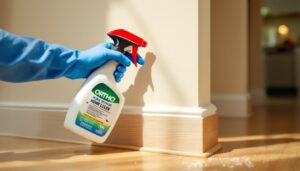
Application strategy determines how well the product works. Start with a clean, dry surface, dust, grease, and moisture reduce adhesion and effectiveness. Sweep or vacuum baseboards before spraying.
Indoor application zones:
- Baseboards and floor-wall junctions in kitchens, bathrooms, basements, and entryways
- Around door frames, window sills, and thresholds
- Behind appliances, under sinks, and along pipes where insects enter
- In cracks and crevices where bugs hide (use the included crack-and-crevice tip)
Outdoor application zones:
- Foundation perimeter, creating a 12-inch band up the wall and 12 inches out onto the ground
- Around door and window frames on the exterior
- Along deck joists, under eaves, and around utility penetrations
Hold the spray wand 12 inches from the surface and apply in a steady, overlapping pattern. Don’t drench, light, even coverage is more effective than pooling liquid. One gallon typically treats up to 1,200 linear feet of baseboard or a foundation perimeter around a 2,500-square-foot home.
Avoid spraying on countertops, food-contact surfaces, or areas where children and pets spend time on the floor until the product has dried. The label prohibits use on edible gardens or near water sources. Always read and follow label directions, they’re legally binding and written to maximize safety and performance.
For severe infestations or structural pest issues (termites, carpenter ants in walls), Ortho Home Defense is a stopgap, not a solution. Those problems need a licensed pest control professional and possibly structural repairs.
How Long Does Ortho Home Defense Last?
The manufacturer claims up to 12 months of indoor protection and up to 3 months outdoors, but real-world performance depends on environmental factors.
Factors that shorten residual life:
- UV exposure: Sunlight degrades pyrethroids rapidly. Shaded foundations last longer than south-facing walls.
- Moisture: Rain, irrigation overspray, and high humidity wash away or dilute the active ingredients.
- Surface type: Porous surfaces like bare wood and concrete absorb and hold the product longer than slick surfaces like painted metal or vinyl.
- Foot traffic: High-traffic baseboards in hallways wear down faster than those in closets.
- Temperature extremes: Heat accelerates chemical breakdown: freezing and thawing cycles can degrade surface adhesion.
Indoor applications in climate-controlled spaces with minimal cleaning hold up best. Outdoor treatments in rainy climates or on surfaces exposed to sprinklers may need reapplication every 4 to 6 weeks during peak bug season. Following seasonal maintenance schedules can help homeowners time reapplications for maximum effectiveness.
Visual cues help gauge when to reapply: if you start seeing bugs again in previously treated areas, the barrier has likely degraded. Don’t wait for a full infestation, reapply at the first sign of activity.
Is Ortho Home Defense Safe for Pets and Kids After It Dries?
The label states the product is safe for pets and children to re-enter treated areas once surfaces are completely dry, typically 1 to 2 hours depending on temperature and humidity. This isn’t marketing fluff, it’s based on toxicology data submitted to the EPA during the registration process.
Pyrethroids have low acute toxicity to mammals because our liver enzymes (esterases) rapidly break them down and excrete metabolites. Insects lack these detox pathways, making the chemicals far more toxic to them. But, “low toxicity” doesn’t mean zero risk.
Precautions to take:
- Keep kids and pets out of the area during application and until dry.
- Avoid spraying pet bedding, toys, or food bowls.
- Don’t apply to surfaces where crawling infants spend time unless you can keep them off those areas until dry.
- If a pet licks a freshly treated surface, contact a vet. Symptoms of pyrethroid exposure in pets include drooling, tremors, and lethargy.
- Wash hands after handling the sprayer or treated surfaces.
Personal protective equipment (PPE) during application:
- Long sleeves and pants
- Nitrile or rubber gloves
- Safety glasses or goggles (the spray can drift or splash)
Ventilate the area during and after indoor application. Open windows and run fans to clear any airborne mist. The water-based formula has low odor compared to older solvent-based insecticides, but proper ventilation is still good practice.
Cats are more sensitive to pyrethroids than dogs due to slower metabolism of these compounds. Don’t let cats groom themselves after walking on freshly treated floors. If you have aquariums or terrariums, cover them and turn off air pumps during application, pyrethroids are highly toxic to fish and amphibians.
For households with chemical sensitivities or very young children, consider alternative pest control methods like diatomaceous earth, boric acid dusts in wall voids, or exclusion tactics (sealing cracks, fixing screens, door sweeps) before reaching for chemical sprays.
Conclusion
Ortho Home Defense works by delivering a neurotoxic punch to insects while remaining relatively safe for humans and pets once dry. Its effectiveness hinges on proper application, clean surfaces, continuous barriers, and strategic placement along entry points and travel routes. Reapply based on environmental exposure and insect activity, not just the calendar. And remember, no spray replaces good housekeeping and exclusion. Seal cracks, fix screens, and eliminate food and moisture sources to make your home less inviting in the first place.