Table of Contents
ToggleIf you’ve grabbed a bottle of Ortho Home Defense to tackle spiders, ants, or roaches, you might wonder what’s actually inside. It’s one of the most popular insect barrier sprays on the market, but most homeowners never flip the bottle around to read the fine print. Understanding the ingredients, both active and inactive, helps you use it safely, apply it effectively, and decide if it’s the right fit for your household. Whether you’re worried about pets, kids, or just want to know what you’re spraying along your baseboards, this breakdown gives you the facts without the marketing gloss.
Key Takeaways
- Ortho Home Defense ingredients contain 0.05% bifenthrin, a synthetic pyrethroid that disrupts insect nervous systems and creates a barrier lasting up to 12 months indoors.
- The remaining 99.95% comprises inactive ingredients like water, surfactants, and emulsifiers that help the active ingredient stick to surfaces and penetrate pest hiding spots effectively.
- Bifenthrin is EPA-classified as moderately toxic for direct contact but poses minimal risk to pets and children once dried, though it’s highly toxic to fish and aquatic organisms.
- Surface prep is critical—wiping baseboards and door frames removes dust and grime, allowing bifenthrin to bond more effectively for better pest control results.
- Natural alternatives like essential oils and diatomaceous earth are safer but require weekly reapplication, while Ortho Home Defense provides longer-lasting residual protection for moderate to heavy infestations.
- Follow drying times of 30 minutes to an hour, avoid treating areas with crawling infants, and reapply every 3–6 months for sustained effectiveness against ants, roaches, and spiders.
What Are the Active Ingredients in Ortho Home Defense?
The active ingredient in most Ortho Home Defense formulas is bifenthrin, a synthetic pyrethroid that targets the nervous systems of insects. As of 2026, the standard Ortho Home Defense Insect Killer for Indoor & Perimeter contains 0.05% bifenthrin. That might sound like a small percentage, but it’s concentrated enough to kill and repel a wide range of crawling pests.
Bifenthrin works by disrupting sodium channels in insect nerve cells, causing paralysis and death. It’s effective against ants, roaches, spiders, centipedes, earwigs, and other common household invaders. The low concentration makes it relatively low-toxicity for humans and pets when used as directed, but it’s still a pesticide, not a household cleaner.
Some specialized Ortho formulas, like their Max or Outdoor variants, may include additional actives or slightly higher concentrations. Always check the label on the specific product you’re using. The EPA registration number and ingredient list are printed on the back of every bottle.
Understanding Bifenthrin: The Primary Pest Fighter
Bifenthrin is a broad-spectrum insecticide in the pyrethroid family, meaning it mimics the natural pest-fighting compounds found in chrysanthemum flowers. Unlike natural pyrethrins, though, bifenthrin is photostable, it doesn’t break down quickly under UV light, which is why Ortho Home Defense claims to create a barrier that lasts up to 12 months indoors.
It’s a contact insecticide, so bugs don’t have to ingest it. When an insect walks across a treated surface, bifenthrin binds to their exoskeleton and enters their nervous system. Death isn’t instant, it can take hours, but the chemical interferes with their ability to navigate, feed, and reproduce.
Bifenthrin is classified by the EPA as a Category II toxicant (moderately toxic) for dermal exposure and Category III (slightly toxic) for oral ingestion in its concentrated form. Once diluted and dried on surfaces, the risk drops significantly. Still, it’s toxic to aquatic organisms and bees, so never spray it near ponds, streams, or flowering plants where pollinators forage.
For DIYers concerned about chemical exposure, bifenthrin has been widely studied. It’s approved for residential use, but pregnant women, people with respiratory sensitivities, and those with compromised immune systems should take extra precautions during application.
Inactive Ingredients and Their Role in Effectiveness
The remaining 99.95% of Ortho Home Defense is made up of inactive ingredients, but “inactive” doesn’t mean useless. These compounds serve as carriers, stabilizers, and spreaders that help bifenthrin stick to surfaces and penetrate pest hiding spots.
Common inactive ingredients include:
- Water: The primary carrier in ready-to-use formulas.
- Surfactants: Help the spray adhere to non-porous surfaces like baseboards, tile, and metal thresholds.
- Glycols or glycerin: Act as humectants to slow evaporation and extend the drying time, giving the active ingredient more contact time.
- Emulsifiers: Keep the oil-based bifenthrin suspended in water so it doesn’t separate in the bottle.
Ortho doesn’t disclose every proprietary ingredient, but the formulation is designed to minimize odor and residue. You won’t get the strong chemical smell common with older organophosphate sprays.
One overlooked detail: inactive ingredients can affect how well the spray performs on different surfaces. On porous materials like unsealed wood or concrete, the formula soaks in. On sealed tile or vinyl, it forms a thin film. That’s why many homeowners applying treatments along home maintenance checklists find better results when they prep surfaces first, wipe down baseboards to remove dust and grime before spraying.
Safety Considerations for Pets and Children
Ortho Home Defense is labeled for indoor use, but that doesn’t mean you should spray it while kids and pets are running around. The product label states clearly: keep people and pets out of the area until the spray has dried, typically 30 minutes to an hour depending on ventilation and humidity.
Once dry, bifenthrin binds to surfaces and poses minimal risk to humans and warm-blooded animals. Dogs and cats can walk on treated floors without issue. That said, bifenthrin is highly toxic to fish and aquatic invertebrates, so never use it near aquariums or allow runoff into drains that lead to septic systems or waterways.
Birds and reptiles are more sensitive than mammals. If you keep parrots, lizards, or amphibians, move them to another room during application and keep them out until the treated area is fully dry and aired out.
For households with crawling infants or curious toddlers, consider treating only along the perimeter, behind appliances, under cabinets, and along wall-floor junctions, rather than wide-open floor areas. Bifenthrin’s residual effect means you don’t need to coat every square inch.
PPE for application:
- Long sleeves and pants
- Nitrile or rubber gloves
- Safety glasses if spraying overhead or in enclosed spaces
- Ventilate the area well during and after application
If accidental ingestion occurs, say, a pet licks a wet surface or a child touches it and puts hands in mouth, call Poison Control (1-800-222-1222) or a vet immediately. Bring the product label with you.
How Ortho Home Defense Ingredients Compare to Natural Alternatives
Homeowners wary of synthetic pyrethroids often turn to natural or botanical insecticides. Products based on essential oils (peppermint, clove, rosemary) or diatomaceous earth are marketed as safer alternatives, but they come with trade-offs.
Natural pyrethrins, derived from chrysanthemum flowers, are fast-acting and break down quickly, making them safer around pets and kids. But they also degrade in sunlight within hours, so they don’t provide the long-lasting barrier that bifenthrin does. You’ll need to reapply weekly or even daily for sustained control.
Essential oil sprays can repel some insects, but they rarely kill on contact. They’re better suited for prevention than active infestations. Diatomaceous earth works mechanically (it dehydrates insects), but it’s messy, slow, and ineffective in humid environments.
According to reviews on product testing platforms, bifenthrin-based products consistently outperform natural alternatives in both knockdown speed and residual protection. If you’re dealing with a moderate to heavy infestation, or trying to keep pests out of a basement, garage, or crawl space, synthetic options like Ortho Home Defense are usually more effective.
That said, natural products have their place. For light pest pressure in kitchens or nurseries, a food-grade spray might be a better fit. Just manage your expectations: you’ll trade longevity for peace of mind.
Application Best Practices for Maximum Results
Even the best formula won’t work if you apply it wrong. Here’s how to get the most out of Ortho Home Defense:
1. Prep the surface. Wipe down baseboards, door frames, and window sills to remove dust, grease, and cobwebs. Bifenthrin needs clean contact with the surface to bond effectively.
2. Shake the bottle. Even though it’s ready-to-use, a quick shake ensures the active ingredient is evenly distributed.
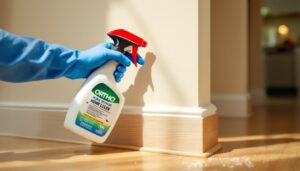
3. Hold the nozzle 12 inches from the surface. Spray a continuous 4-inch band along baseboards, door thresholds, window frames, and any cracks or gaps where insects enter. You want visible wetness, but not dripping puddles.
4. Focus on entry points and harborages. Treat along the foundation perimeter outside, around utility penetrations (pipes, vents, cables), behind appliances, and inside closets or storage areas where pests hide.
5. Let it dry completely. Don’t mop or wipe treated areas for at least 24 hours. The longer bifenthrin stays in place, the better the residual barrier.
6. Reapply as needed. Ortho claims up to 12 months indoors, but high-traffic areas, moisture, and cleaning will reduce effectiveness. Most pros recommend retreating every 3-6 months or when you start seeing activity again.
Tool alternatives: The Ortho Home Defense trigger sprayer works fine for small jobs. For whole-house treatments or exterior perimeters, a pump sprayer gives you more control and less hand fatigue. Just make sure it’s dedicated to pesticides, never use it for fertilizers or herbicides afterward.
Many comprehensive home guides recommend treating both indoors and out for complete coverage, especially in spring and fall when insect activity peaks.
Conclusion
Knowing what’s in Ortho Home Defense, and how it works, turns a simple spray-and-forget task into a smarter, safer pest control strategy. Bifenthrin is effective, well-studied, and relatively low-risk when used correctly. Pair that knowledge with proper surface prep, targeted application, and common-sense safety measures, and you’ll get reliable results without guesswork.